Project FEED was the title for a commissioned piece of work which responded to the research project ‘Cow’s Eat Grass, Don’t They?‘ by Agricultural Sociologist Dr Orla Shortall, The James Hutton Institute, Aberdeen. Orla’s research was commissioned by The British Academy which later gave way to the opportunity featured in The British Academy Summer Showcase in June 2021.
The summer showcase provided the opportunity to show the trailer for FEED for the first time alongside discussions regarding British and Irish dairying. It was my role in this event to moderate the session which, alongside myself and Orla, featured Dr Ollie Douglas from the Museum of English Rural Life and Ned Palmer from The Cheese Tasting Co. You can watch the full showcase event here below via YouTube:
More on Project FEED…
The aim of Project FEED was to create a short film that both highlights and celebrates the diversity of dairy farming in the UK and Ireland. Project FEED asked UK and Irish dairy farmers to participate by contributing short video clips of their farms. The goal was to simply answer the question: ‘What does a modern dairy farm look like?’ and contrast this with the geo-economic and geo-political individuality that uniquely positions all dairy farms despite their visual similarities.
The project took place during the COVID-19 pandemic, and my initial intention was to visit farmers in person and gather verbal, written and visually recorded materials to create the film. However, it was soon apparent that this approach was not going to be a viable option in lock-down conditions. In order to gather content from farmers across the UK and Ireland, I produced a filming instruction booklet to guide farmers in what video clips to shoot. The instruction booklet asked farmers to send their video clips to a specially set-up mobile phone via Whatsapp. This ensured safe and easy transfer of recorded content remotely. Each farmer was sent the instruction book featured below in the post with a box of Porsham Cakes brownies.
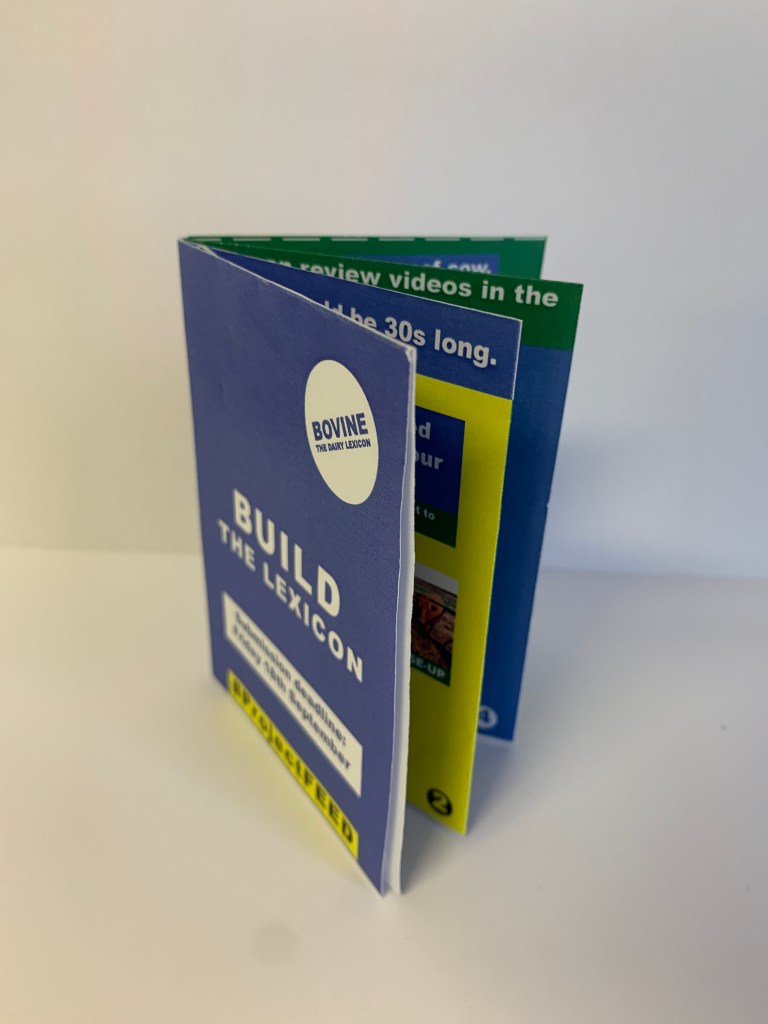


In addition to the instruction booklet, a website was set-up specifically to facilitate the project called ‘The Dairy Lexicon’ as both a point of contact and to hold information for timely aspects of the project. The name was chosen to follow on from a publication I produced in 2017 titled ‘BOVINE The Dairy Lexicon’. The website for the project was shut down at the end of 2021 when the project was complete.
Once the video clips were received I became to storyboard ideas for the film where I began collaborating with Robbie McKane. Robbie’s expertise in film and video enabled me to realise the ambitions of my project to superimpose the farmers videos over the top of additional footage shot by Robbie in 4k. Three specially made screens were used to achieve this and placed in shot to create a blank canvas upon which to virtually display the farmers videos. In doing this I was able to re-introduce the clips into an agricultural setting in order to avoid them from becoming isolated singular moving images on screen.
Voice over audio was created using anonymised and specially selected sentences and comments made by farmers she had interviewed and released exclusively for the project from Orla’s research. These short pieces of text were then carefully matched with voice artists which aimed to represent farmers involved from Scotland, Ireland, Wales and England.
The film was shown in full for the first time at Lismore Castle Arts, Lismore, Co. Waterford, Ireland at the conference ‘The Rural Re-Imagined‘ in November 2021. The trailer for the film can be found under Works in the menu and is listed by its title: FEED
I would not have been able to produce this film without the support of highly skilled creative professionals whom are all listed in the credits of the film. Particular thanks extend to Steph Mitchel and Robbie McKane among many others for their time, patients and professionalism working with me.
 Adam Stead